
The Elm Bank we know today originally started life in 1836 when on the first day of July the gentleman on the right, a Manchester silk merchant by the name of William Bindloss, leased land from the Rev Thomas Blackburn, the vicar of St Mary’s in Eccles.
There he built a house which his wife referred to as “ the country cottage” and it subsequently became known as Elm Bank. Why here? Anlarge open field site, good transport links into Manchester and because the silk mill on Silk street was his. He and his partner Edward Preston built houses next door to each other on what became Bindloss Avenue and Preston’s Avenue.
William died in 1872 and such was the wealth of the area that when William’s wife Ann died at Elm Bank on the 28th July 1881 her personal estate came to £153,877 and 7 shillings . Or into day’s terms £10,184,326 and 25 pence.

Between 1845 and 1921 Elm Bank was the Bindloss family home, then a school, and from 1914 to 1918 the house was a red cross volunteer hospital and this picture of the house taken during that period is the only early photograph of Elm Bank that up to now has been traced.
It is believed to have been taken by E.J. Care a professional photographer and a member of Andrew lodge No 3328. Thirty one nurses and staff served at the hospital from 1914 to 1918 two got married while there and one died on November 30th 1918 after a short illness following duties on the influenza ward.
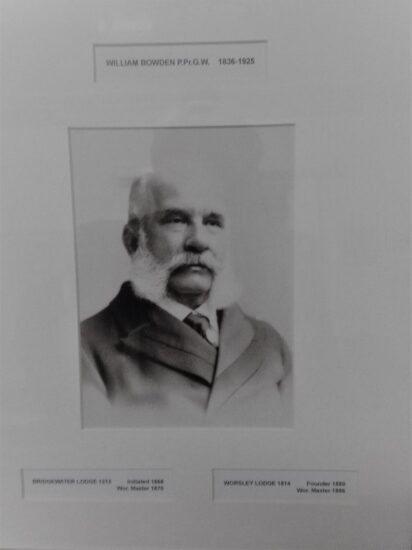
In 1918 /1919, W L C Bowden a solicitor and member of Bridgewater Lodge applied to Bridgewater estates to change the use of Elm Bank from a school to a Masonic Hall and at this time the Masonic club was formed.
The assembly rooms on Monton Lane and other premises had been used for masonic functions and meetings by lodges but now the lodges felt, it was time to have their own premises.
The hall was officially dedicated under the auspicies of Bridgewater Lodge and the lodges in Eccles started to move in.
The Cooking was done on the first floor where an apartment is now and dinning was on the ground floor. The washing up was done in the basement. Ladies evenings were held upstairs in the lodge room whose oak block floor was good to dance on and the ladies liked the big arm chairs.
Over time the masons have added and subtracted to Elm Bank to best suit the needs of the Lodges . The banqueting hall was added in the late fifties early sixties. The kitchen, masonic dining room, offices and ladies rest room in the 1980’s.
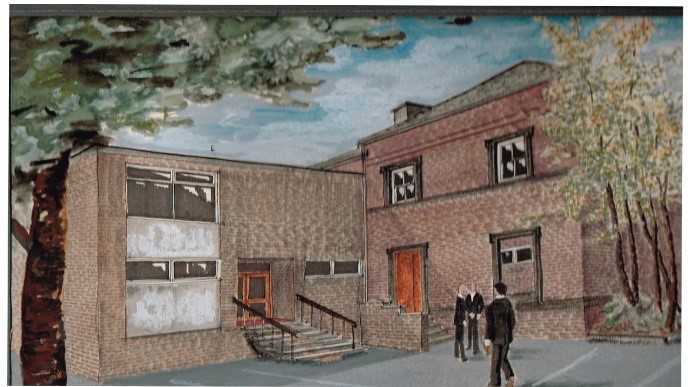
This painting was done in 1980 by Bro A White. Note the two entrances one on the left for functions and on the right to the masonic club.
Over the years our home has hosted many events, masonic and otherwise, and welcomed many visitors, for installations, charity and social events Christmas Concerts and especially our ladies evenings.
Winston S Churchill, the wartime leader and freemason said in October 1943 about rebuilding the commons, “We shape our buildings there after they shape us.” Long may Elm Bank continue to do so
